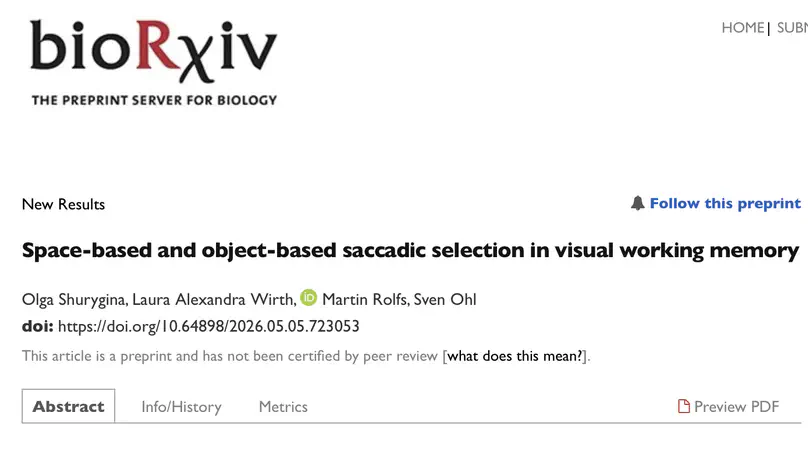
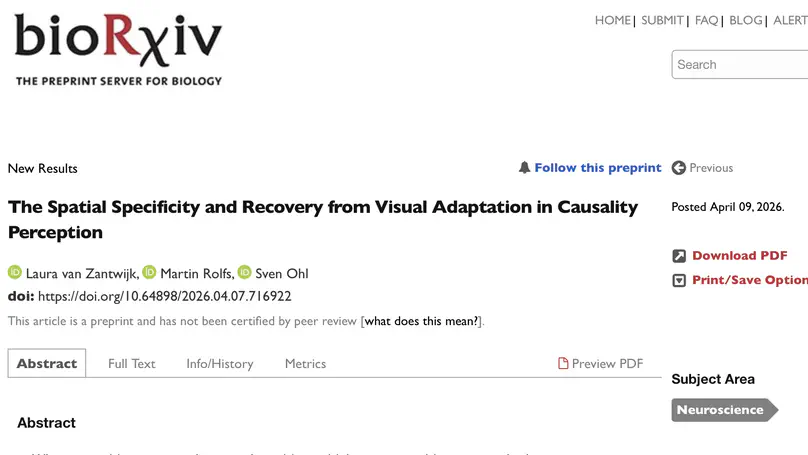
The MIAlab (PI: Sven Ohl) is an Experimental Psychology lab located at the University of Applied Sciences Magdeburg-Stendal. We are funded by the Heisenberg Program of the Deutsche Forschungsgemeinschaft. In our research, we study vision and memory in action, and how humans process causal interactions in their sensory environment. The lab’s core methods include psychophysics, eye tracking and applied statistics.
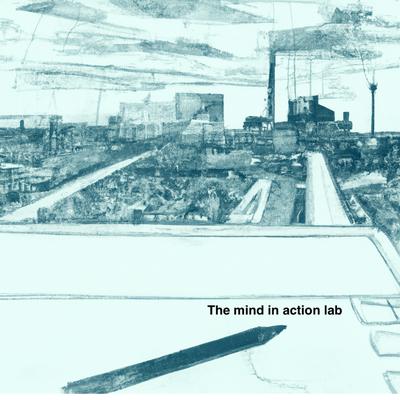
If you don’t know why you ended up on this website, then try out the visual turntable and have some fun setting things in motion. (Note, this might not be supported by all browsers.)
The MIAlab is moving to Stendal. We are grateful for the many wonderful years at Humboldt-Universität zu Berlin that shaped our thinking. Now we are excited to begin a new chapter at the University of Applied Sciences Magdeburg-Stendal, where Sven will take on the Professorship for General Psychology. We look forward to the new opportunities, collaborations, and ideas that this move will bring. Thank you, Berlin – and hello Stendal.
Since the current semester, we have been lucky to welcome multiple new students to the lab. Laura Ackermann and Maria Fischer are conducting causality experiments in the lab as part of their bachelor theses in Psychology. Lara Ramp is working on microsaccades in her bachelor thesis. Gamze Kahyaoglu and Tessa Chambon are interns from The Netherlands enrolled in the Neuroscience and Cognition master programme. Gamze is doing a research project on corrective saccades, and Tessa is doing a literature assignment as well as an EEG project. Welcome to the lab all, we’re happy to have you! [authored by LvZ]
An exciting science summer is coming to an end. Laura presented her current experiments at the summer school in Tübingen and deepened her knowledge of statistics at the summer school “Statistical Methods for Linguistics and Psychology” in Potsdam. Inchara presented her work on ensemble perception at ECVP in Mainz while Ben had the chance to learn more about visual perception at a summer school in Pisa.
This paper on the visibility of saccade-like motion has been long in the making and is finally out. In a tour de force this paper shows that the perceptual thresholds for high-speed motion perception during fixation can be predicted based on the lawful kinematics of saccadic eye movements. Check out the paper just published in Nature Communications https://www.nature.com/articles/s41467-025-58659-9 and the press release https://www.scienceofintelligence.de/too-fast-to-see-eye-movements-predict-speed-limits-in-perception/.